


Starting from the 2025/2026 academic year, a practical clinical final exam will be required to complete the medicine program.
OSCE is a standardized assessment method used at the end of the sixth year of the University of Tartu Medical School curriculum. The exam aims to objectively and structurally assess a student's practical clinical skills and ability to demonstrate them in simulated clinical situations.
Why is OSCE necessary? Standardizing the assessment reduces its variability and ensures that the skills of all graduates of the curriculum are at the level necessary for clinical work. OSCE assesses whether a student knows something and whether he or she can apply this knowledge in practice. Until now, different supervisors have assessed practical skills in different practice bases, but in the case of OSCE, the assessment is uniform and comparable. The exam is assessed on a pass/fail basis.
When does the exam take place?
The OSKE takes place at the end of the sixth year.
In 2026, the OSKE will be held from May 18–29.
- The Estonian-language exam will take place from May 25–29.
- The English-language exam will take place on May 22.
- May 18–21 are reserve days for students outside the curriculum.
What does the exam look like?
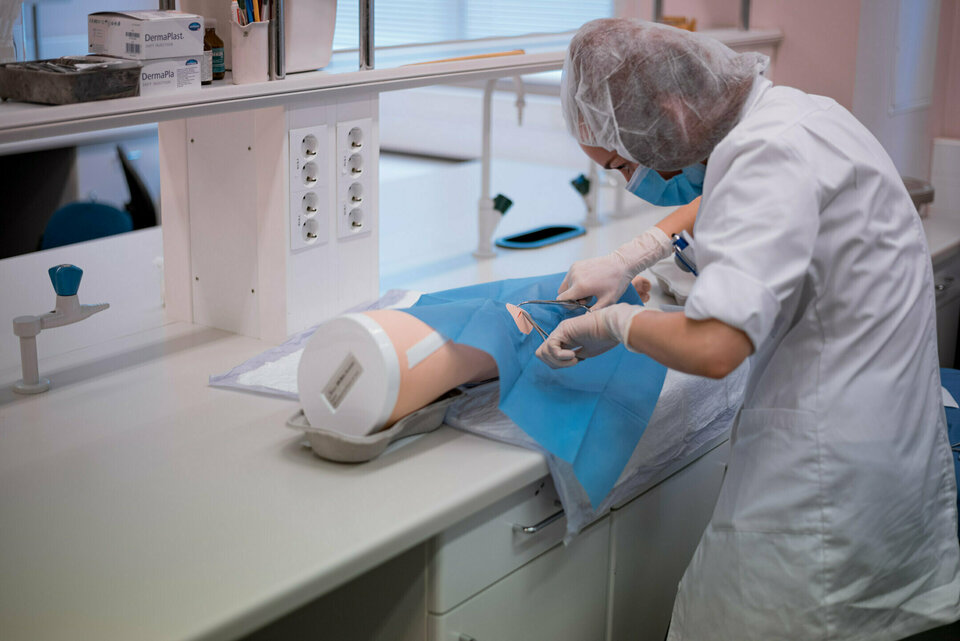
The exam has 10–15 stations. Each station has one task, which the student has 8 minutes to complete. The tasks are created based on realistic clinical situations.
The performance of each task is assessed by 1–2 instructors and marked against standardised scoring rubrics.
After completing the task, the student has 2 minutes to move to the next station and familiarise themselves with the new task.
The exam is considered complete if the student completes the tasks of all stations.
What skills are assessed in the exam? OSCE assesses the skills marked as mandatory in the current list of practical skills.
Frequently Asked Questions
OSCE takes place at the end of the sixth year. The exact schedule will be announced during the academic year.
Yes. According to the final examination regulations, all OSCE stations must be completed. This does not mean the performance has to be perfect—minor mistakes are allowed. However, for certain skills there may be so-called “critical errors” at a station, and making such an error means the station is failed (e.g. failing to recognize a life-threatening rhythm). These are critically important criteria where an error would jeopardise patient safety.
- 2026 is a transition year: the OSCE is considered passed for everyone who comes to the exam and attempts to complete the tasks; mistakes are not taken into account. However, a thorough analysis of both exam results and organizational aspects will be conducted.
- From 2027 onward, the OSCE will be threshold-based and passing it will be a prerequisite for admission to the written final exam.
For each mandatory practical skill, a list of activities will be created in Moodle describing, in general terms, what needs to be done to demonstrate the skill correctly. If critical errors are defined for a given mandatory practical skill, they will be explicitly listed.
Sharing full assessment sheets is not always practical from a learner’s perspective, because:
- the same practical skill may be assessed with different emphases in different years or exam sessions;
- guidance should be general and directional, rather than narrowly tied to the assessment sheet of one specific station.
An important principle: during the exam, it is expected that the student completes the task within the given time. For example, if a student notices a breach of sterility and corrects it but does not manage to finish the task, they receive points only for the components they were able to demonstrate correctly. If the goal of the task is achieved during the station, the station is considered passed; if not, it is considered failed.
The OSCE organising team reminds responsible teaching staff to pay attention to the OSCE. In addition, information is disseminated through the Dean’s Office and institutes.
If there are lecturers who are not yet aware of the OSCE or cannot answer your questions, please forward their contact details to the examination committee so that they can be informed.
Reaching supervisors at clinical placement sites is more challenging, and here the student also plays an important role: when starting a placement, the student should explain to the supervisor which skills need to be acquired and practised during the placement. It should also be agreed how this practice will take place and how feedback will be provided.
The OSCE team itself is not responsible for organising placements or standardising placement sites, but:
- exam results and students’ areas of concern are shared with clinical practice coordinators;
- if necessary, attention is drawn to quality differences (e.g. between what is taught at the university and practices used at different placement sites).
It is assumed that the level of skills required to pass the OSCE is sufficiently consistent across Estonia. For most mandatory practical skills, international guidelines exist against which one can compare clinical practice at the practice site.
For example:
- guidelines for the treatment of type 2 diabetes (international guidelines are acceptable);
- guidelines for the treatment of hypertension (both Estonian and European versions are acceptable).
Evidence-based variations in task performance are allowed in the OSCE. For example, empirical antibiotic choices may differ between hospitals, but if they are based on valid guidelines, they are acceptable in the exam.
In the future, the OSCE will also become one tool for assessing the quality of placement sites.
The OSCE lead is responsible for organisational aspects of the exam, including:
- the exam schedule and location;
- exam day logistics;
- organisation of examiners and stations;
- organising resit exams;
- organising information sessions related to OSCE logistics;
- training instructors and teaching staff for the OSCE;
- other organisational matters related to the OSCE.
The content of practical skills and students’ preparation for the exam fall under the responsibility of the relevant teaching staff, clinical placements, and curriculum organisers. Both the OSCE and the written final exam are summative assessments, meaning they provide a final, overall evaluation of the knowledge and skills acquired throughout the curriculum. This differs from formative assessment, whose purpose is to provide feedback and support learner development.
The role of exam organisers is to ensure fairness and alignment with the curriculum, not to provide separate exam-specific teaching or practice. It is assumed that exam preparation occurs through prior courses and the 6th-year clinical practice.
The new list of practical skills can be implemented only after the corresponding changes have been made to the curriculum. Currently, the 2016-approved list is in use and forms part of the curriculum.
If concrete plans emerge to introduce the new list, this will be announced well in advance, and an assessment will be made as to whether students have been sufficiently prepared.
No. The Dean’s Office has decided that OSCE mock exams will no longer be organised.
Research does not convincingly show that mock exams improve final practical exam results. Therefore, there is currently no evidence-based justification for directing limited resources toward organising mock exams. It is considered more appropriate to allocate resources where they will have a greater impact.
Some references:
- Chisnall, Ben & Vince, Tushar & Hall, Sarah & Tribe, Rachel. (2015). Evaluation of outcomes of a formative objective structured clinical examination for second-year UK medical students. International journal of medical education. 6. 76-83. 10.5116/ijme.5572.a534.
- Madrazo L, Lee CB, McConnell M, Khamisa K, Pugh D. No observed effect of a student-led mock objective structured clinical examination on subsequent performance scores in medical students in Canada. J Educ Eval Health Prof. 2019;16.14. doi: 10.3352/jeehp.2019.16.14
- Alkhateeb NE, Al-Dabbagh A, Ibrahim M, Al-Tawil NG. Effect of a Formative Objective Structured Clinical Examination on the Clinical Performance of Undergraduate Medical Students in a Summative Examination: A Randomized Controlled Trial. Indian Pediatr. 2019 Sep 15;56(9):745-748. PMID: 31638006.
The mock OSCE was taken by 5th-year students who had not yet completed the full curriculum, including the full scope of clinical placements that usually precede the final exam. Therefore, conclusions about the expected performance of 6th-year students cannot be drawn from these results.
No. In the real OSCE, only skills marked as mandatory in the practical skills list (designated solely with the letter S) and previously tested will be assessed.
- Exam organisation and technical questions: Gerhard Grents ([email protected])
- OSCE Moodle: Gerhard Grents ([email protected])
- Practical skills guidelines: responsible teaching staff
- Simulation centre: simulation education specialists René Lepik ([email protected]) or Raul Jalast ([email protected]), phone 731 8016
The OSCE is based on knowledge acquired throughout the entire curriculum. Foundational knowledge certainly comes from earlier years, but practising skills and achieving proficiency currently occur mainly during the practice year. A similar situation applies to the written final exam: foundational knowledge comes from earlier years, while the final year focuses on revision and consolidation.
In such cases, the final exam committee analyses the situation. If the problem lies in the design of exam tasks or stations, it is possible to exclude faulty tasks or the results of specific stations from the overall OSCE score. Decisions are made by the exam committee.
Didn't find the information you needed? Leave your question in the form below! The answers will appear in the FAQ section.
